Nilgiri striped squirrel Taxonomy Distribution References Navigation menu10.2305/IUCN.UK.2008.RLTS.T8703A12926423.en"Family Sciuridae"Mammal Species of the World: a taxonomic and geographic reference26158608The Nilgiri striped squirrel (Funambulus sublineatus), and the dusky striped squirrel (Funambulus obscurus), two additions to the endemic mammal fauna of India and Sri Lanka."The systematics of the dusky striped squirrel, Funambulus sublineatus (Waterhouse, 1838) (Rodentia: Sciuridae) and its relationships to Layard's squirrel, Funambulus layardi Blyth, 1849"10.1080/00222933.2011.626126efunambulus-sublineatus31308724372474593510229241632354870312400579693659expanding ite
IUCN Red List vulnerable speciesFunambulusMammals of IndiaMammals of Sri LankaMammals described in 1838Squirrel stubs
Funambulus obscurusrodentSciuridaeIndiaSri Lanka
Nilgiri striped squirrel
Jump to navigation
Jump to search
| Nilgiri striped squirrel | |
|---|---|
 | |
Conservation status | |
 Vulnerable (IUCN 3.1)[1] | |
Scientific classification  | |
| Kingdom: | Animalia |
| Phylum: | Chordata |
| Class: | Mammalia |
| Order: | Rodentia |
| Family: | Sciuridae |
| Genus: | Funambulus |
| Species: | F. sublineatus |
Binomial name | |
Funambulus sublineatus (Waterhouse, 1838) | |
| Subspecies | |
See text[2] | |
Synonyms | |
Funambulus kathleenae Thomas & Wroughton, 1915 | |
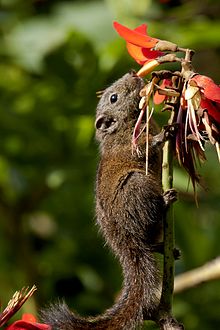
The Nilgiri striped squirrel (Funambulus sublineatus) is an Indian squirrel (formerly subspecies F. s. sublineatus) once referred to as the Dusky-striped squirrel when it was regarded as a subspecies of a similar Sri Lankan species (Funambulus obscurus). It is a species of rodent in the family Sciuridae.
Taxonomy
The species known in the past has recently been split into two species. The Indian form (formerly subspecies F. s. sublineatus) has now been referred to as the Nilgiri striped squirrel based on the oldest available common name from 1880[3], whereas the Sri Lankan form (formerly F. s. obscurus) is now allocated Dusky striped squirrel first used in 1884.[4]
Distribution
The former range of the species, before the taxonomic split[5] was in both India and Sri Lanka, though the Nilgiri palm squirrel (F. sublineatus) is now restricted in distribution to the Western Ghats of India. Very little is known of this squirrel, probably the smallest in the genus weighing about 40g. Its new status as an endemic mammal to India means records need updating.
The species is confined to wet humid forests either in the Western Ghats and Nilgiri hills (and surrounding areas such as around Kodaikanal in India)
References
^ Rajamani, N.; Molur, S. & Nameer, P. O. (2008). "Funambulus sublineatus". The IUCN Red List of Threatened Species. IUCN. 2008: e.T8703A12926423. doi:10.2305/IUCN.UK.2008.RLTS.T8703A12926423.en..mw-parser-output cite.citationfont-style:inherit.mw-parser-output .citation qquotes:"""""""'""'".mw-parser-output .citation .cs1-lock-free abackground:url("//upload.wikimedia.org/wikipedia/commons/thumb/6/65/Lock-green.svg/9px-Lock-green.svg.png")no-repeat;background-position:right .1em center.mw-parser-output .citation .cs1-lock-limited a,.mw-parser-output .citation .cs1-lock-registration abackground:url("//upload.wikimedia.org/wikipedia/commons/thumb/d/d6/Lock-gray-alt-2.svg/9px-Lock-gray-alt-2.svg.png")no-repeat;background-position:right .1em center.mw-parser-output .citation .cs1-lock-subscription abackground:url("//upload.wikimedia.org/wikipedia/commons/thumb/a/aa/Lock-red-alt-2.svg/9px-Lock-red-alt-2.svg.png")no-repeat;background-position:right .1em center.mw-parser-output .cs1-subscription,.mw-parser-output .cs1-registrationcolor:#555.mw-parser-output .cs1-subscription span,.mw-parser-output .cs1-registration spanborder-bottom:1px dotted;cursor:help.mw-parser-output .cs1-ws-icon abackground:url("//upload.wikimedia.org/wikipedia/commons/thumb/4/4c/Wikisource-logo.svg/12px-Wikisource-logo.svg.png")no-repeat;background-position:right .1em center.mw-parser-output code.cs1-codecolor:inherit;background:inherit;border:inherit;padding:inherit.mw-parser-output .cs1-hidden-errordisplay:none;font-size:100%.mw-parser-output .cs1-visible-errorfont-size:100%.mw-parser-output .cs1-maintdisplay:none;color:#33aa33;margin-left:0.3em.mw-parser-output .cs1-subscription,.mw-parser-output .cs1-registration,.mw-parser-output .cs1-formatfont-size:95%.mw-parser-output .cs1-kern-left,.mw-parser-output .cs1-kern-wl-leftpadding-left:0.2em.mw-parser-output .cs1-kern-right,.mw-parser-output .cs1-kern-wl-rightpadding-right:0.2em
^ Thorington, R.W., Jr.; Hoffmann, R.S. (2005). "Family Sciuridae". In Wilson, D.E.; Reeder, D.M (eds.). Mammal Species of the World: a taxonomic and geographic reference (3rd ed.). The Johns Hopkins University Press. pp. 754–818. ISBN 0-8018-8221-4. OCLC 26158608.
^ Grigg, H.B. (1880). A Manual of the Nilagiri District in the Madras Presidency. Madras: Government Press.
^ Rajith Dissanayake. 2012. The Nilgiri striped squirrel (Funambulus sublineatus), and the dusky striped squirrel (Funambulus obscurus), two additions to the endemic mammal fauna of India and Sri Lanka. Small Mammal Mail. Vol 3(2):6-7
^ Dissanayake, Rajith; Oshida, Tatsuo (2012). "The systematics of the dusky striped squirrel, Funambulus sublineatus (Waterhouse, 1838) (Rodentia: Sciuridae) and its relationships to Layard's squirrel, Funambulus layardi Blyth, 1849" (PDF). Journal of Natural History. 46 (1–2): 91–116. doi:10.1080/00222933.2011.626126.
 | This squirrel article is a stub. You can help Wikipedia by expanding it. |
Categories:
- IUCN Red List vulnerable species
- Funambulus
- Mammals of India
- Mammals of Sri Lanka
- Mammals described in 1838
- Squirrel stubs


(RLQ=window.RLQ||[]).push(function()mw.config.set("wgPageParseReport":"limitreport":"cputime":"0.680","walltime":"1.043","ppvisitednodes":"value":8321,"limit":1000000,"ppgeneratednodes":"value":0,"limit":1500000,"postexpandincludesize":"value":69943,"limit":2097152,"templateargumentsize":"value":7020,"limit":2097152,"expansiondepth":"value":17,"limit":40,"expensivefunctioncount":"value":12,"limit":500,"unstrip-depth":"value":1,"limit":20,"unstrip-size":"value":14048,"limit":5000000,"entityaccesscount":"value":12,"limit":400,"timingprofile":["100.00% 984.658 1 -total"," 51.68% 508.827 1 Template:Speciesbox"," 50.85% 500.673 1 Template:Taxobox/core"," 21.15% 208.219 1 Template:Taxonbar"," 19.32% 190.277 1 Template:Reflist"," 9.80% 96.494 2 Template:Cite_journal"," 7.78% 76.610 2 Template:Cite_book"," 7.07% 69.630 44 Template:Delink"," 3.64% 35.818 1 Template:Redirect"," 2.39% 23.572 1 Template:S._Callosciurinae_nav"],"scribunto":"limitreport-timeusage":"value":"0.499","limit":"10.000","limitreport-memusage":"value":4488710,"limit":52428800,"cachereport":"origin":"mw1271","timestamp":"20190910052853","ttl":2592000,"transientcontent":false););"@context":"https://schema.org","@type":"Article","name":"Nilgiri striped squirrel","url":"https://en.wikipedia.org/wiki/Nilgiri_striped_squirrel","sameAs":"http://www.wikidata.org/entity/Q308491","mainEntity":"http://www.wikidata.org/entity/Q308491","author":"@type":"Organization","name":"Contributors to Wikimedia projects","publisher":"@type":"Organization","name":"Wikimedia Foundation, Inc.","logo":"@type":"ImageObject","url":"https://www.wikimedia.org/static/images/wmf-hor-googpub.png","datePublished":"2007-07-30T01:25:06Z","dateModified":"2019-09-06T11:00:18Z","image":"https://upload.wikimedia.org/wikipedia/commons/5/5b/Dusky_striped_squirrel_by_N_A_Nazeer.jpg","headline":"species of rodent found in India and Sri Lanka"(RLQ=window.RLQ||[]).push(function()mw.config.set("wgBackendResponseTime":116,"wgHostname":"mw1270"););


