Small-eared dormouse References | Navigation menuGraphiurus microtis2006 IUCN Red List of Threatened Species. eadding to it
IUCN Red List least concern speciesGraphiurus
rodentGliridaeAngolaBotswanaEritreaEthiopiaKenyaLesothoMalawiMozambiqueNamibiaSouth AfricaSudanSwazilandTanzaniaZambiaZimbabwe
Small-eared dormouse
Jump to navigation
Jump to search
| Small-eared Dormouse | |
|---|---|
Conservation status | |
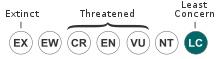 Least Concern (IUCN 3.1) | |
Scientific classification | |
| Kingdom: | Animalia |
| Phylum: | Chordata |
| Class: | Mammalia |
| Order: | Rodentia |
| Family: | Gliridae |
| Genus: | Graphiurus |
| Species: | G. microtis |
Binomial name | |
Graphiurus microtis (Noack, 1887) | |
The Small-eared Dormouse (Graphiurus microtis) is a species of rodent in the Gliridae family. It is found in Angola, Botswana, Eritrea, Ethiopia, Kenya, Lesotho, Malawi, Mozambique, Namibia, South Africa, Sudan, Swaziland, Tanzania, Zambia, and Zimbabwe.
References |
- Holden, M. E.. 2005. Family Gliridae. Pp. 819-841 in Mammal Species of the World a Taxonomic and Geographic Reference. D. E. Wilson and D. M. Reeder eds. Johns Hopkins University Press, Baltimore.
- Schlitter, D. & Grubb, P. 2004. Graphiurus microtis. 2006 IUCN Red List of Threatened Species. Downloaded on 29 July 2007.
 This short article about biology can be made longer. You can help Wikipedia by adding to it.
Categories:
- IUCN Red List least concern species
- Graphiurus


(RLQ=window.RLQ||[]).push(function()mw.config.set("wgPageParseReport":"limitreport":"cputime":"0.220","walltime":"0.286","ppvisitednodes":"value":4635,"limit":1000000,"ppgeneratednodes":"value":0,"limit":1500000,"postexpandincludesize":"value":58713,"limit":2097152,"templateargumentsize":"value":5351,"limit":2097152,"expansiondepth":"value":25,"limit":40,"expensivefunctioncount":"value":0,"limit":500,"unstrip-depth":"value":0,"limit":20,"unstrip-size":"value":296,"limit":5000000,"entityaccesscount":"value":0,"limit":400,"timingprofile":["100.00% 247.660 1 -total"," 75.48% 186.941 1 Template:Taxobox"," 72.40% 179.318 1 Template:Taxobox/core"," 48.07% 119.044 14 Template:Taxobox_colour"," 42.97% 106.424 14 Template:Delink"," 33.62% 83.252 4 Template:Navbox"," 24.60% 60.929 7 Template:Taxonomy"," 22.24% 55.070 1 Template:Gliridae_nav"," 19.93% 49.348 1 Template:If_empty"," 17.23% 42.663 11 Template:Sets_taxobox_colour"],"scribunto":"limitreport-timeusage":"value":"0.050","limit":"10.000","limitreport-memusage":"value":2130317,"limit":52428800,"cachereport":"origin":"mw1310","timestamp":"20190820195447","ttl":2592000,"transientcontent":false););"@context":"https://schema.org","@type":"Article","name":"Small-eared dormouse","url":"https://simple.wikipedia.org/wiki/Small-eared_dormouse","sameAs":"http://www.wikidata.org/entity/Q1767304","mainEntity":"http://www.wikidata.org/entity/Q1767304","author":"@type":"Organization","name":"Contributors to Wikimedia projects","publisher":"@type":"Organization","name":"Wikimedia Foundation, Inc.","logo":"@type":"ImageObject","url":"https://www.wikimedia.org/static/images/wmf-hor-googpub.png","datePublished":"2010-01-11T23:37:55Z","dateModified":"2015-02-12T10:33:02Z","headline":"species of mammal"(RLQ=window.RLQ||[]).push(function()mw.config.set("wgBackendResponseTime":101,"wgHostname":"mw1255"););


